
Betting News
Are Prediction Markets Creating a Regulatory Blind Spot in South Africa?

SportsBoom offers honest and impartial bookmaker reviews to help you make informed choices. While we may earn commissions through affiliate links, our content remains independent and free from promotional influence. For more information, see our Content Transparency and How We Review pages.
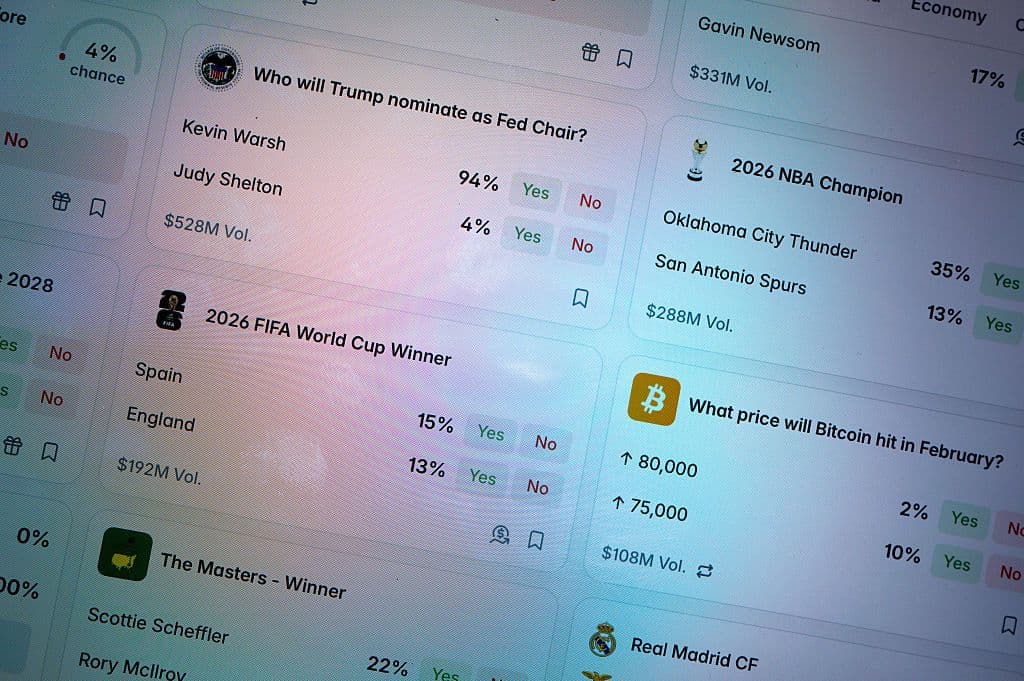
Prediction Markets Face Increased Scrutiny Over Insider Trading Allegations by Scott Olson | Getty Images
Questions are emerging over how prediction markets should be treated under South Africa’s gambling laws, with the South African Bookmakers’ Association (SABA) warning that a regulatory blind spot could give offshore platforms an advantage over licensed operators.
The debate centres on whether prediction markets are fundamentally different from traditional betting products and whether they should be subject to the same licensing, tax and consumer protection requirements.
Mateusz Mazur, Head of US Content at iGaming Express, spoke exclusively to SportsBoom on September 21, 2026, while SportsBoom also interviewed iGaming consultant Phillip Gray on October 12, 2026, to examine the implications for South Africa’s betting industry.
“Honestly, the structural difference between a prediction market and a betting exchange is much smaller than the market would have you believe. In both cases users trade against each other and the platform takes a fee. Classification is what drives licensing, tax and consumer protection, so at the end of the day, a product shouldn't get to pick its regulator just by picking its vocabulary,” Mazur told SportsBoom.co.za.
Why Prediction Markets Are Raising Concerns in South Africa
SABA raised concerns about prediction markets in a position paper published in July 2026, arguing that platforms offering contracts on political and other real-world events could operate outside the regulatory framework governing licensed bookmakers.
The association also highlighted potential risks to market integrity, consumer protection and fair competition, warning that platforms operating beyond the established gambling framework could gain an advantage over regulated businesses.
One example cited by SABA was a Polymarket market on who would become Johannesburg’s next mayor. The association pointed to a News24 report stating that more than R700,000 had been wagered on the outcome.
The growing popularity of markets linked to politics, geopolitics and economic developments has also prompted major international sportsbooks to explore the sector, despite restrictions on the types of events they can offer.
Gray highlighted how some of the industry's biggest operators are responding to that demand.
“Certainly these products or "events" (non-sporting, geopolitical, and macroeconomic occurrences) that sportsbooks are barred from offering are quite popular. These are prone to insider trading as we've seen in North America with numerous illegal trading being discovered. The biggest brands here FanDuel / DraftKings etc have now launched their own shadow site prediction offerings to counter but are still restricted in exactly what they can offer.”
For South Africa, the question is whether prediction markets can be accommodated within existing gambling legislation or whether a clearer regulatory framework is required.
Where South African Gambling Law Leaves Questions Unanswered
South Africa’s National Gambling Act 7 of 2004 covers bets on uncertain outcomes, including those made through electronic communication. However, that does not automatically mean every betting product is permitted, with operators also required to comply with relevant provincial laws and the conditions attached to their licences.
The distinction between different types of betting products is already a point of contention. In October 2026, ITWeb reported that SABA had challenged the North West Gambling Board’s authority to issue betting-exchange licences under the bookmaker category.
SABA requested the legal basis for those licences, although the report did not establish that they were invalid.
Against that backdrop, Gray questioned whether prediction markets should be treated as a fundamentally different product from existing forms of betting.
“Unless there's a change to current SA laws that would allow prediction sites to operate there, I don't believe there would be the impetus for legal sportsbooks to have to offer these markets. They are in essence the same as current sporting events being wagered upon. Although predictions are considered "peer-to-peer," these are still bets, and the prediction sites charge a commission on each transaction, thus enabling them to act as "the house."
The classification matters because licensed bookmakers must operate within a framework of tax obligations, responsible gambling requirements and advertising restrictions. If offshore prediction markets can offer similar products without meeting those obligations, regulated businesses could find themselves competing on unequal terms.
Mazur believes that imbalance could become a significant challenge for South Africa’s licensed betting sector.
“The problem is really one of asymmetry. A licensed operator carries tax, responsible gambling duties and advertising rules, and an offshore platform can just skip all of that.
"On top of that, it can offer markets a local bookmaker isn't allowed to touch, so the regulated side ends up looking like the less innovative option. Over time, that chips away at the whole argument for licensing, which is that the legal market is the better choice for the consumer,” Mazur added.
He believes prediction markets could become a more immediate competitive threat if they gain traction among local users and enforcement remains limited.
He thinks that prediction markets in South Africa could “become a real competitive issue if three things line up: easy local payments, local sport on the menu and weak enforcement.”
Market Integrity and Consumer Protection Pose Challenges for Regulators
The regulatory questions extend beyond competition between bookmakers and offshore platforms. Prediction markets linked to political decisions, corporate developments and other real-world events can create risks that differ from those associated with conventional sports betting.
Prediction markets tied to political and corporate events raise questions about how regulators can monitor trading activity, identify potential misuse of confidential information and ensure that consumers are adequately protected.
Mazur identified market integrity, anti-money laundering (AML) compliance and consumer protection as the principal concerns.
“For me, market integrity is the hardest one. With prediction markets, you're dealing with events where the insiders aren't athletes but officials or company staff, and there's simply no established framework for monitoring that. AML comes right after, because peer-to-peer flows, cross-border users and crypto make the money much harder to follow. Consumer protection is actually the most solvable of the three. The tools already exist; the obstacle is jurisdiction.”
The risks associated with trading on non-public information have already attracted regulatory attention in the United States.
In August 2026, the US Commodity Futures Trading Commission (CFTC) ordered former White House employee Gabriel Perez to disgorge $107,539.02 in trading profits after he used non-public information about presidential speeches to trade prediction contracts.
Perez was also ordered to pay a $65,000 civil monetary penalty and was banned from trading for three years.
The case illustrates how prediction markets can raise questions about the use of privileged information, particularly when contracts are tied to decisions or events involving people with access to confidential details.
Gray also questioned whether South African consumers using offshore prediction platforms receive the same safeguards expected of licensed gambling operators.
“Currently to my knowledge prediction markets, like illegal offshore gaming sites, do not have geo-blocks in place for South Africa. So I would surmise that many South Africans are likely members of these sites. Unregulated sites generally have far less stringent "know your customer " mechanisms and do not adhere to what are now considered " responsible gambling " guidelines. Age restrictions, proof of funds capability etc.”
Without effective oversight, regulators could face difficulties enforcing age restrictions, checking customers’ sources of funds and ensuring that platforms meet responsible gambling standards.
The challenge is therefore not limited to determining whether prediction markets fall within existing legislation. It also involves establishing how regulators can monitor activity on platforms operating across borders and outside South Africa’s licensing system.
What Comes Next for Prediction Markets in South Africa?
The future of prediction markets in South Africa will depend in part on how regulators interpret existing legislation and whether further clarification is needed to distinguish permissible betting products from those operating outside the law.
For licensed bookmakers, the issue is also about whether they should be allowed to offer comparable products under an appropriate regulatory framework, rather than losing potential customers to offshore platforms.
Mazur believes the underlying activity should determine the regulatory obligations, rather than the terminology used by a platform. He also argued that regulators should consider the specific risks associated with different types of events.
“If people are staking money on an uncertain outcome to make a profit, the core betting obligations should apply, whatever the product is called. I'd also want regulators to be deliberate about which events are acceptable at all, because sport and elections carry very different risks.
And crucially, let licensed operators offer exchange-style products under the same rules. That way innovation happens inside the regulated market, not offshore.”
His position highlights the central question facing South Africa’s gambling industry: how can regulators protect consumers, maintain market integrity and ensure fair competition without preventing legitimate innovation?
For now, prediction markets remain a developing regulatory challenge. The way South Africa addresses their classification and oversight could have significant implications for licensed bookmakers, offshore platforms and consumers alike.

Christian Glory is a Sports Betting and iGaming Journalist with over 5 years of experience creating content for top publications. Her work spans casino reviews, sports betting, poker, tournament coverage, industry analysis, and editorial content.
Related Resources to Betting News
- Can Playson’s World Sports Betting Deal Reshape South Africa’s Slot Lobbies?
- Why Ethiopia's Betting Market Relaunch Matters to South African Operators
- Brazil Has Banned Online Betting So Could South Africa Be Next?
- Can South Africa’s New Illegal Gambling Task Team Finally Stop Unlicensed Operators?
- GiG's 888Africa Deal Reveals What Really Matters in African Gambling
- Could Micro-Betting Be the Next Big Advantage for Sportsbooks?
- Are Player Props Becoming a Problem for Sportsbooks?
- Why Gambling Operators Are Raising the Bar for Affiliate Partnerships
- Can Traditional Casinos Survive the Online Gambling Boom? Industry Expert Reveals What Comes Next
- How Live Betting Has Transformed Sports Wagering, According to Industry Insider
- Can Sportsbooks Keep World Cup Bettors Once the Tournament Ends? LiveScore Expert Delivers Verdict
- Are Prediction Markets the Future of Sports Betting? Industry Expert Explains the Threat to Sportsbooks
- Are Free Bets and No Deposit Bonuses Still Worth Claiming?
- Government's 20% Betting Tax Could Boost Illegal Gambling, Warns SABA CEO
- Cluster-Pay Slots vs Payline Slots: Which is Easier?
- Mines vs Aviator: Which Game Is Better?
- Pre-Match Betting Explained: What it is & How it Works
- Why South African Bettors Are Switching Between Betting Apps
- How Well Do Betting Operators Educate New Players
- Expert Warns of Financial, Legal and Data Risks on Unlicensed Online Gambling Platforms