
Betting Academy
BTTS Betting Explained: Strategy, Odds & Expert Insights
I thought I’d found an easy BTTS wager when Fulham travelled to Nottingham Forest on 15 March. Nottingham’s home xG was 1.68, and they were on average conceding 1.27 goals per match, while Fulham was also giving up 1.67 goals away. However, the game was a stinker with just 3 shots on target in total and ended in a 0-0 draw.

SportsBoom offers honest and impartial bookmaker reviews to help you make informed choices. While we may earn commissions through affiliate links, our content remains independent and free from promotional influence. For more information, see our Content Transparency and How We Review pages.
BTTS Betting Explained!
I failed to research just how poorly Fulham was playing away, averaging only 10 shots and failing to beat the keeper in 33% of matches. I’ve taken that lesson on board, I’ll never bet on an away side without checking their failure-to-score percentage and the divergence between away and home shots.
Explore the trusted betting operators to see which statistics matter when it comes to BTTS and how to identify matches where goals will be flowing!!
What Is BTTS Betting?
Both teams to score, or BTTS, is a Yes/No market where you're wagering on whether both sides will find the net at least once during a match. You can find ongoing Premier League bet offers for BTTS.
What Is BTTS Betting
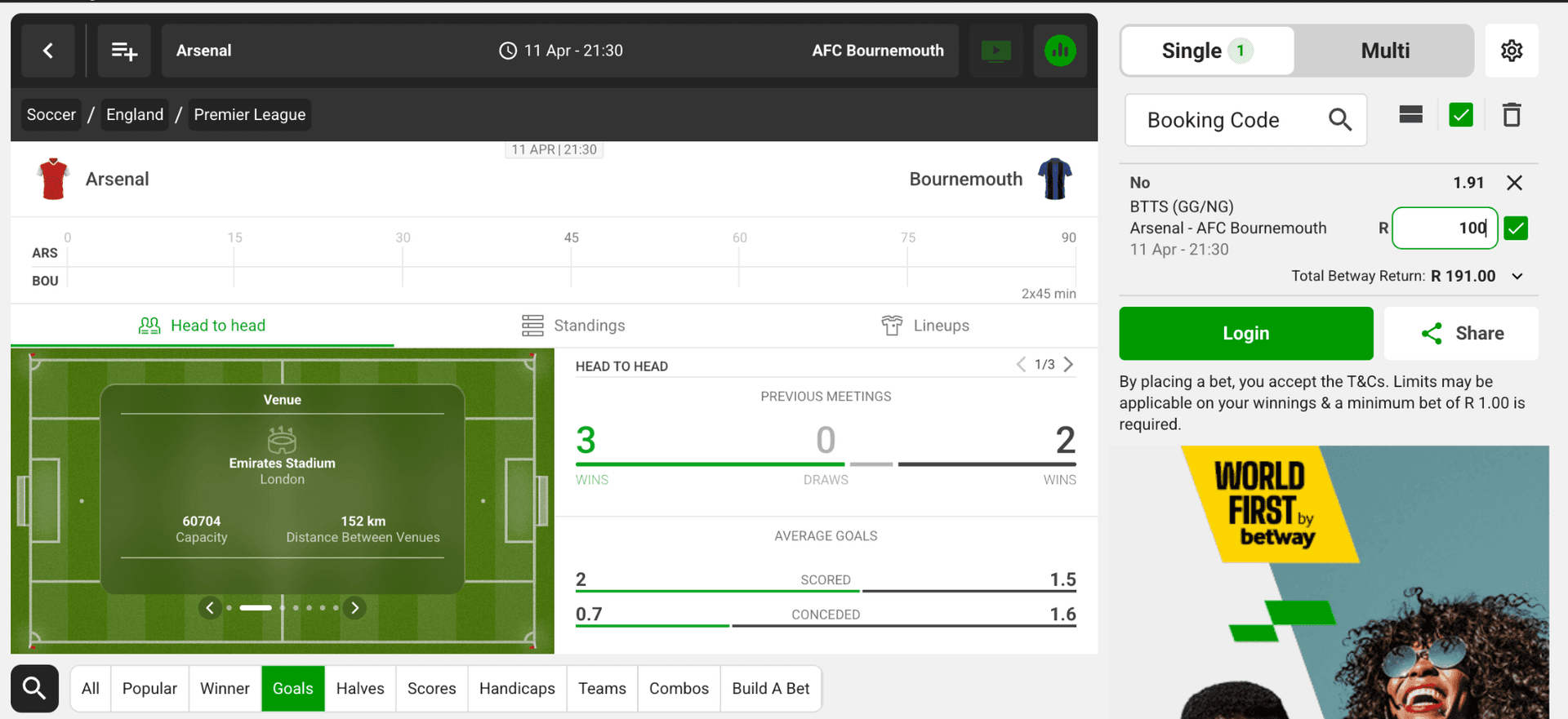
For example, after exploring trusted betting platforms, I was looking at the Arsenal vs Bournemouth clash on the 11th of April. No was paying 1.91, which seems like value considering Arsenal has the best defence in the EPL, is conceding just 0.60 goals per game at the Emirates this season, and is averaging 53% clean sheets!
During the 2025/2026 EPL season Man Utd has a 74% BTTS rate that’s 18% above the league average. Source: FootyStats
How to Bet BTTS Properly
I start by scanning fixtures for BTTS odds that look intuitively soft, prices that don't feel right given what I know about both sides. When I spot one, I build my own probability independently before touching the bookmaker's line.
I pull six data points: xG for, xG against, average goals scored over the last five matches, recent head-to-head scorelines, and recent results at the specific venue. I convert those into my own implied probability and compare it to the bookmaker's price.
Recently, I was considering betting on BTTS Yes at 1.49 on Chelsea vs Man City, 12th April. On the surface, it looks reasonable, as Chelsea are averaging 1.71 goals scored and 1.23 conceded per game this season, and City are averaging 2.03 goals per game. Haaland alone is averaging 0.99 xG per 90 this season, with chances worth 16.1 xG, more than Sunderland or Wolves have generated in total.

How to Bet BTTS Properly
However, the Stamford Bridge venue does change things a bit. Chelsea have a 33% clean sheet record at home this season, and City have failed to score in 20% of away matches. After adjusting for the venue and City’s poor away performances this season, I put the true implied probability around 61%, well below Betway’s 67%.
Drivers of Real Value
From what I’ve seen, most punters find a BTTS bet by looking at two attacking teams and assuming goals will flow, but that type of surface analysis doesn’t cut it. Take your betting process deeper with soccer betting tips by looking for setups like:
Set-Piece Mismatches
In 2025-26, a Premier League record 19% of all goals have come from corners alone, and 30% of all goals this season have come from set pieces. When a team with a strong set-piece setup faces a side with poor aerial defending, the probability of that team scoring increases significantly regardless of their open-play xG.
Take Arsenal, for example, the Gunners have scored 27 set-piece goals since the start of last season, yet their team total and BTTS odds are priced primarily on open-play metrics.
Home/Away BTTS Rate Divergence
In the 2024-25 Premier League season, BTTS landed in 218 of 380 matches, just over 57%, but that league-wide average masks enormous variance between home and away fixtures at the team level.
For example, Chelsea saw BTTS in only 37% of their home games last season, but an impressive 79% of their away games ended with BTTS. The bookie’s odds don’t always price such a dramatic difference accurately.
xG Regression — When a Team Is Overdue a Correction
When a team is scoring significantly above their xG, regression is coming. Nottingham Forest overperformed their xG by 13 goals in 2024-25, the biggest overperformance in the Premier League that season, and their late-season stumble was a direct consequence of that regression catching up with them.
Crystal Palace, meanwhile, underperformed their xG by 10 goals, scoring 10 fewer than their chances warranted. The result was BTTS Yes in Palace fixtures was consistently underpriced because the bookmaker treated their poor scoring record as a true reflection of their attacking quality rather than misfortune.
Case Study - BTTS Yes — West Ham vs Brentford | 10th March 2026 | FA Cup R5
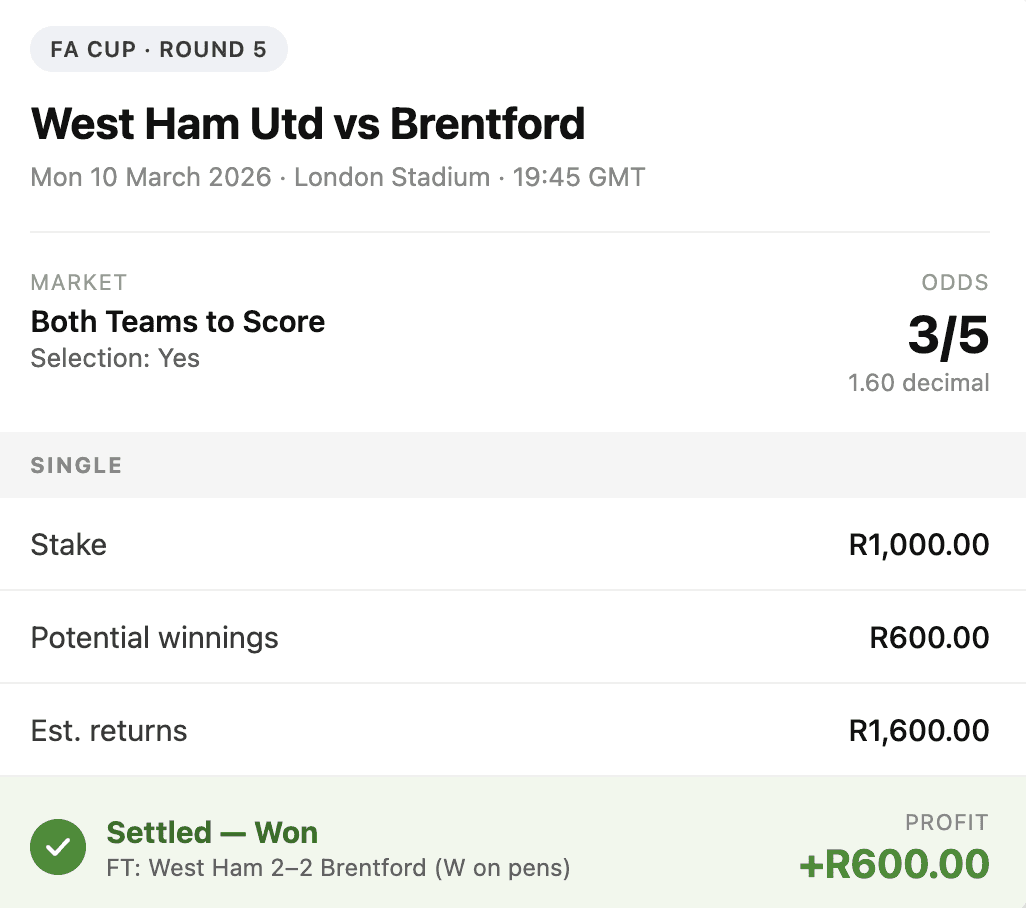
After checking out SportsBoom’s tips, I placed R1,000 on BTTS Yes at odds of 1.60. West Ham had kept clean sheets in just 7% of their home games, essentially one clean sheet all season at the London Stadium. Their xG at home was 1.64 per game; opponents were consistently generating nearly two expected goals' worth of chances every time they visited.
Case Study Btts
Brentford's away record was equally telling. They were averaging 1.25 goals per game on the road, reliable scorers even away from home. But crucially, their xG against away from home sat at 1.54, confirming they were wide open defensively when travelling.
The bookie priced BTTS Yes at 62.5% implied probability. My analysis, weighted across both teams' attacking output and defensive vulnerability, put the true probability at ~76%, which gave me more than enough margin to place the wager.
The match ended up being an absolute goal fest, with Jarrod Bowen and Igor Thiago both scoring in the first half and then both scoring again in the second. The match finished 2-2 after 90 minutes, and the Hammers ended up triumphing during penalties. My R1,000 bet returned R1,000!
BTTS.
When to Avoid BTTS
Not every fixture deserves a BTTS bet. These are three scenarios where the data consistently says walk away.
- 1
When a Dominant Home Side Has a Low BTTS Rate
Home advantage suppresses BTTS rates significantly, and backing BTTS Yes against a defensively dominant home side is one of the most reliable ways to lose money in this market.
For example, Liverpool's home BTTS rate in 2024-25 was just 37%, and they kept clean sheets relentlessly at Anfield, making BTTS Yes a losing bet in nearly two-thirds of their home fixtures. - 2
When the Home Team Is Averaging Under 0.9 Goals Per Game
A team's home and away BTTS rates can differ dramatically. A side scoring in 80% of home games but only 50% of away games produces a very different BTTS probability depending on where they're playing.
For example, Nottingham Forest's 39% BTTS rate, the lowest in the Premier League in 2025-26, is driven largely by their unusually poor home scoring record, where they fail to score in 60% of fixtures. - 3
When Match Context Removes the Incentive to Attack
When both teams need a result but neither wants to risk conceding, like in a top-four battle or a relegation match where a draw is acceptable, the match context suppresses BTTS rates regardless of what the season averages suggest. Defensive managers who favour low-scoring games produce a BTTS No rate of 54-59%, and that rate rises further when the tactical caution is reinforced by match stakes.
BTTS Checklist
Your personal connection with a team or a recent big win can completely cloud your judgment before the analysis even starts. I’ve specifically built this checklist to cut through that noise:
- Has the home team scored in each of their last six home league fixtures?
- Has the away team scored in at least five of their last seven away league fixtures?
- Is the combined BTTS percentage for both teams above 60%?
- Is the xG ratio between the two teams below 1.5x?
- Is neither team playing their third match in eight days or fewer?
- Does match context give both teams a reason to attack?
- Is there no significant red card risk in this fixture?
Conclusion
The best games to target for BTTS are high-scoring soccer teams playing away against a decent team that tends to overperform at home, for example, Chelsea at Brentford. To find matches that fit the bill, analyse xG, BTTS percentage and average goals scored/conceded home and away.
FAQs
Is BTTS profitable in South African football markets?
It depends heavily on which league you're targeting. The PSL averaged 2.41 goals per game in 2024-25, lower than Europe's top five leagues, so BTTS occurs less frequently than many punters expect.
Is BTTS better in European leagues or the PSL for South African punters?
European leagues offer more data and deeper markets, but PSL fixtures carry less bookmaker scrutiny, so pricing inefficiencies are more common. The Premier League's 2024-25 BTTS hit rate was around 54%, compared to roughly 46% in the PSL.
Does home advantage affect BTTS?
Significantly. Home teams score in a higher percentage of matches than away teams across every major league. In the PSL, away sides failed to score in nearly 38% of fixtures in 2024-25, so BTTS is often a weaker bet for away sides with poor attacking form.
Does recent form or head-to-head record matter more for BTTS?
Recent form is more reliable than historical head-to-head for BTTS because squad composition, tactical shape, and managerial approach change significantly season to season.
Which teams are best to target for BTTS in 2025-26?
Target teams with high attacking output and poor defensive records simultaneously. In 2025-26, Manchester United leads the Premier League for BTTS at 72%, followed by Chelsea at 69% and Bournemouth at 66%. Nottingham Forest sit at the bottom with just 39% BTTS.

Bruce Douglas is an experienced editor and copywriting professional with a proven track record in shaping high-quality content across multiple platforms. With a career spanning journalism, editorial management, and digital content strategy, he brings a keen eye for detail and a passion for precision to every project he works on.
Related Resources to Betting Academy
- Why 1000 Slot Spins Beat a Football Match in Predictability
- House Edge vs Betting Margin: What’s Fairer for Punters?
- Why Long Multiples Appeal to South African Bettors
- PSL Betting Guide: Ignore Streaks, Focus on Data
- How to Use Casino Games to Keep Your Bankroll Active for the 2026 World Cup
- When to Cash Out a Bet Early? A Guide for Football Fans
- How Injuries Shift Betting Odds and Move the Line
- FICA for Beginners: Getting Your Account Ready Before Kick-Off
- Top Soccer-Themed Spina Zonke Games to Play in the Off-Season
- Are PSL Gambling Sponsors Legal in South Africa?
- Why R5 Aviator Bets Are Trending in Sports Bars
- How Release Clauses Affect Transfer Odds
- What to Bet On During Soccer’s Off-Season in South Africa
- Understanding Decimal vs Fractional Betting Odds
- Why Transfer Rumours Shift Betting Odds Quickly
- What Is Single Betting How It Works with Strategy Tips in 2026
- Treble Bets Explained How 3 Leg Accumulators Work in 2026
- Why Transfer Odds Move Before the News?
- How to Hedge Football Transfer Rumours Using Free Bets?
- Asian Handicap Betting Explained: Expert Strategies & Proven Winning Tips