
Betting Academy
Double Chance Betting: What You Need to Know
There’s a moment that most sports punters recognise. You don’t fully trust a team will win, but you follow them, and it feels wrong to bet against them. What you need is a middle ground that feels safe.

SportsBoom offers honest and impartial bookmaker reviews to help you make informed choices. While we may earn commissions through affiliate links, our content remains independent and free from promotional influence. For more information, see our Content Transparency and How We Review pages.

Double Chance Betting
Bettors start to look to trusted betting operators to look for ways to reduce that risk. That’s exactly where Double Change starts to look like an option.
Understanding Double Chance Betting in Real Terms
Basically, Double Chance is a simple game of choice. Instead of backing one result, you back two.
There are three possibilities. There are three types of bets: 1X, where the home team wins or draws, X2, where the visiting team wins or draws, and 12, where there's no draw.
Rather than asking who's going to win, you ask which of the 3 you're ruling out. When you add a second outcome, you’re increasing your chances of winning the bet, even though you are accepting lower odds.
You still lose if the result is that you didn’t take lands. A late goal, a mistake at the back or a game that never really gets going is all it can take. The Double Chance just modifies the risk.
A Quick Example
Let’s say Kaizer Chiefs are playing at home, and these are the options:
- Chiefs to win – 2.20
- Draw – 3.10
- AmaZulu 1X – 1.35
Taking the 1X bet covers two outcomes, but your return drops because of the added safety. A stake of R500 will give you a return of R675.
You have reduced the risk of losing if there is a draw, but also reduced the payout if Kaizer Chiefs win.
How Bookmakers Set Double Chance Odds (and What You’re Really Paying For)
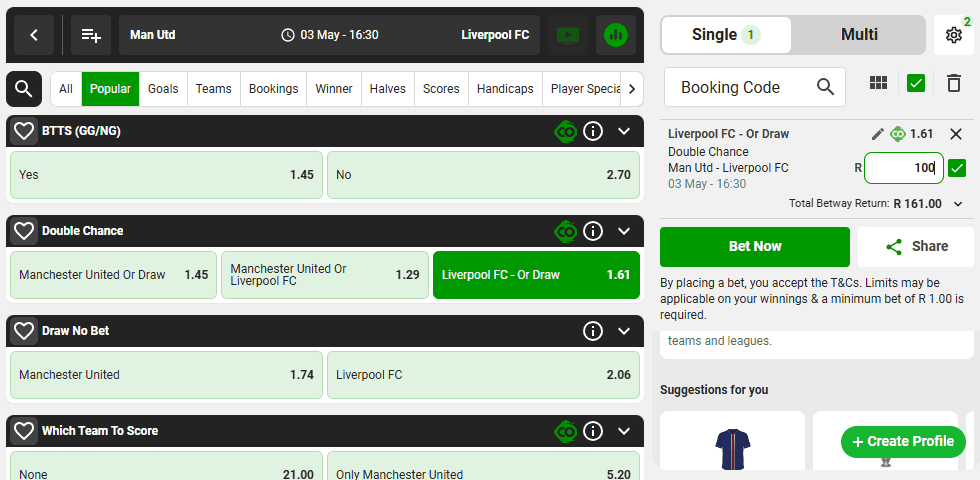
Credit: Betway Sportsbook – Screenshot captured by Jo Davies on 30 April 2026 – 15:25
Even when using expert betting tips and predictions, understanding how markets are priced matters. At first glance, Double Chance odds just look like a smaller version of match odds. But there is a bit more going on behind the scenes.
When you bet something like 1X, the sportsbook combines 2 outcomes (the home win and a draw) into a single set of odds. If the odds drop too far, you’re not reducing the risk; you’re just paying a bit more for the uncertainty.
Best leagues for Double Chance
Some leagues just feel more predictable than others. You’ll see some where the goals keep coming and others that stay tight and slow and are more than likely ending in a draw.
Slower games are your best bet for Double Chance bets because they are balanced and low scori
| League | Suitability | Why it matters |
| PSL (South Africa) | High | Lower-scoring games, higher draw frequency |
| Serie A | High | Tactical matches are often decided by small margins |
| EPL | Medium | More goals, more unpredictability |
| CAF Competitions | Medium–High | Away teams often play cautiously |

In leagues like the PSL, draws are a regular part of the game. That makes 1X or 2X markets feel like the best option.
But there’s a catch, and top soccer betting platforms with competitive odds are already on to it. While Double Chance might fit the league, the odds are often tighter to show it. It’s not spotting something that’s hidden; you’re deciding whether the odds still make sense.
The Real Edge
There are a few times when it makes sense to think about a Double Chance bet:
- The teams are closely matched
- One side is slightly stronger but not dominant
- A draw feels like a realistic outcome
Where it Starts to Fall Apart
In more open leagues, like the EPL, games tend to swing quickly.
A match that looks balanced on paper can turn with one early goal. The team chasing the game opens up, spaces appear, and suddenly the match no longer fits the “tight and cautious” picture you expected. Covering 2 outcomes isn’t the best choice for these games.
A Simple Checklist Before You Bet
Before placing a Double Chance bet, it helps to slow things down and ask yourself:
- Does the game look like it could end in a draw?
- Are the teams well-matched?
- Do the odds still offer value, or have they dropped too far?
Final Thoughts
While most of the examples I have used focus on soccer, the same logic can be used for other sports with three-way outcomes, like cricket or rugby. The idea is still the same.
Double Chance can be a useful tool, especially in leagues like the PSL, where games are often tight and low-scoring. It works best when you take a moment to think about it, not just as a last-minute safe bet.
FAQs
What is Double Chance betting?
Double Chance betting allows you to cover two outcomes in a match instead of one. In football, you can choose 1X (home win or draw), X2 (away win or draw), or 12 (either team wins).
Is Double Chance betting safer than regular bets?
Yes, Double Chance bets are generally safer because they cover two outcomes. However, the trade-off is lower odds and smaller potential returns.
How do bookmakers calculate Double Chance odds?
Bookmakers combine the probabilities of two outcomes into one price and apply a margin. This means you are effectively paying for the added “safety” through reduced odds.
When should you use Double Chance bets?
Double Chance works best in closely matched games or leagues with frequent draws, like the PSL. It’s useful when you expect a tight match with low scoring.
What are common mistakes with Double Chance betting?
A common mistake is assuming it guarantees value. Bettors often ignore how much the odds drop, meaning they may overpay for reduced risk without gaining real value.

Jo Davies is a content writer with a well-rounded background that brings a practical, real-world edge to her work. Before moving into writing, she built experience across a range of industries, including health and safety, administration, petrochemical, medical, skills training, and hospitality. That journey has helped shape her ability to communicate clearly and approach topics with structure and understanding.
Related Resources to Betting Academy
- What Is Lucky 31 Betting and How Does It Work
- Illegal offshore gambling operators continue to challenge SA’s betting market
- Future of Crypto Casinos in South Africa
- World Sports Betting Expands Virtual Sports Offering With Additional Kiron Interactive Content
- Betting Bonuses in South Africa: Reward or Retention?
- Are Licensed Betting Sites in South Africa Actually Safer?
- Are Sportsbooks Ads Taking Over South African Sport?
- South Africa’s Gambling Regulators Are Still Fighting for Turf
- Card Betting Explained: What It Is and How It Works
- Last Goalscorer Betting Explained: How It Works & Odds Guide
- Avoid Withdrawal Problems at SA Betting Sites
- Why Most South Africans Take Cover Bets
- South Africa Weighs 20% Tax on Online Gambling Revenue
- Online Betting Boom Reshapes South Africa’s Gambling Market
- Can Betting Work as a Side Income in South Africa?
- Does Betting in South Africa Add More Fun to Football Matches?
- Anytime Goalscorer: Everything You Need To Know About This Bet Type
- How to Delete Settled Bets in Betway
- Most Popular Sports for Betting in South Africa
- Why FICA Delays Are Still a Huge Problem for South African Bettors