
Betting Academy
Last Team Goalscorer Betting Explained: How the Market Works
Real Madrid is two goals down. You see Jose giving Jude Bellingham a pep talk, you just know what's coming next, a late and last-minute winner. That is what a last team goalscorer is. Someone who knows how to make a difference in those tight situations.

SportsBoom offers honest and impartial bookmaker reviews to help you make informed choices. While we may earn commissions through affiliate links, our content remains independent and free from promotional influence. For more information, see our Content Transparency and How We Review pages.
A typical example is Virgil Van Dijk in the box, being 1-0 down, and all Liverpool has to do is drop it on his head. Who else would you trust?
Essentially, you are choosing the person who will score last for your team. It would not matter if the other team scored afterwards.
What Is Last Team Goalscorer Betting?
It is only about the team's final goal, not the match's final goal; it doesn't matter what the opposing team does afterward. It is NOT a “Last Goalscorer” bet for the entire match; this only takes into consideration the goals scored by the team you choose. It gives you a better chance of winning while offering competitive odds.
Settlement is almost always based on regular playing time (including injury time). Extra time and penalty shootouts typically don't count unless stated.
How Last Team Goalscorer Betting Works
First, you select a team and a player, and you are basically saying which player will be the last to score for that specific team. For example, Manchester United vs Chelsea, you select Bruno Fernandes to be the last scorer for Manchester United, meaning if another Manchester United player scores after that, you will not win.
A “Last Manchester United Goalscorer” market for that fixture might look something like this:
Player | Odds |
Bruno Fernandes | 4.50 |
Harry Maguire | 7.00 |
Senne Lammens | 15.00 |
Maguire would typically have a higher return because he is not an attacker, but we also know it's a possibility that he can score, especially in headers and corners. But, for example, if Maguire scores an own goal, and it counts for Liverpool, it doesn't count because you select Team and Player, and the goal has to count for the Team and the Player.
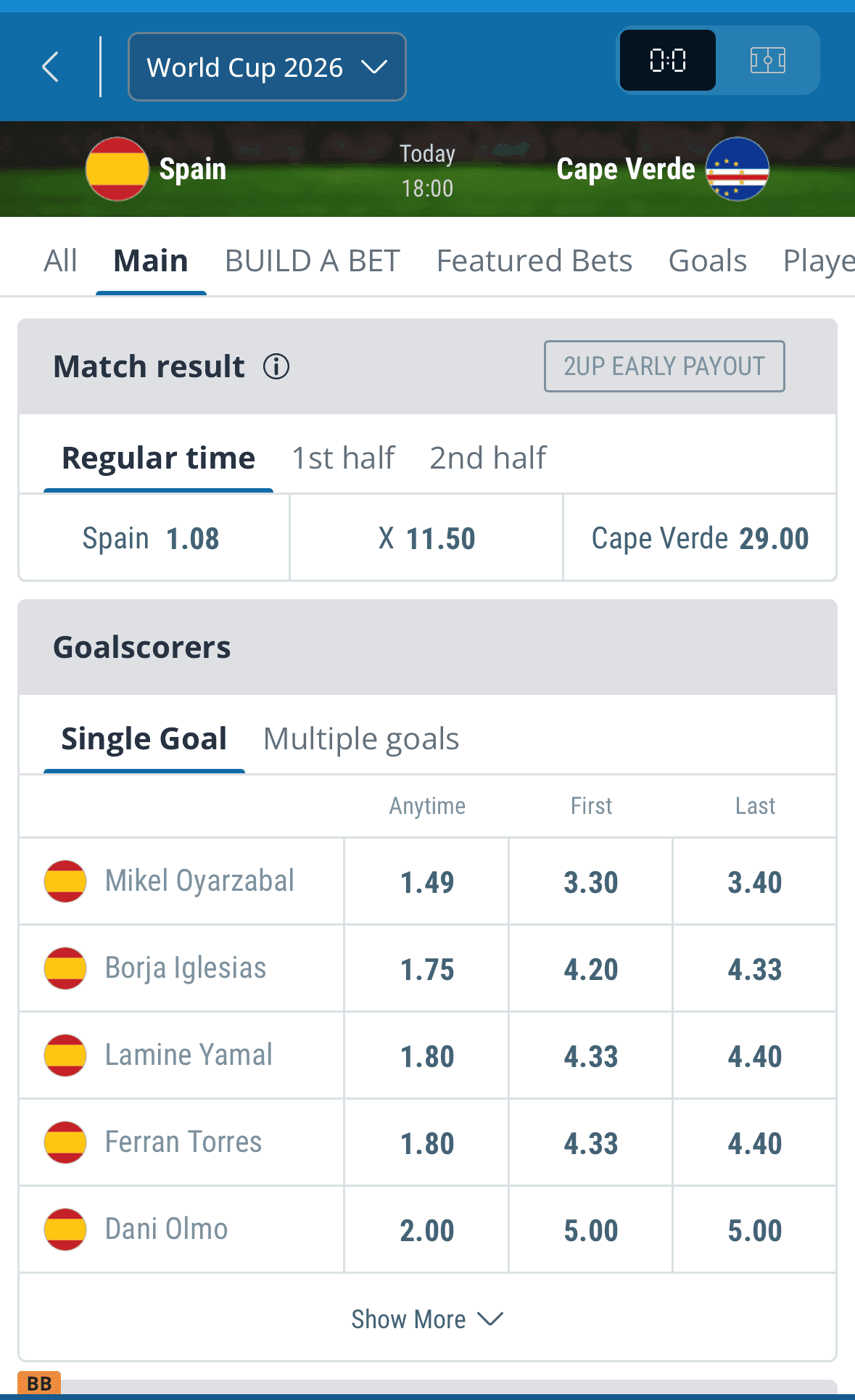
Example: Spain vs Cape Verde, World Cup 2026 – the “Last” column shows last team goalscorer odds for each player. Source: Sportingbet South Africa. Screenshot captured by Umed Swedutt on 15 June, 2026 - 11:48 UTC
How Bookmakers Calculate Last Team Goalscorer Odds
Bookmakers consider the XG, the players' minutes, the match state, and the form of the player. For example, at the start of the season, Casemiro would have had a higher price or better odds, but as the season progressed and he picked up form, the odds would have lowered because he found form.
Further to that would be the match state, and if Bruno is putting in crosses to the box and finding Casemiro, and he looks more likely to score, you would back him, and the odds would continue to drop.
What could also affect the price and odds would be the tactical setup of a game. If Bruno drops back into the midfield, the likelihood of him being as prolific drops, and his price increases. And the other side of that is if he starts in the number 10 position, that price goes higher.
Because so much of this depends on events that have not happened yet, last team goalscorer odds carry more uncertainty than markets settled before kickoff, and they keep moving for as long as the match does.
Factors That Influence Last Team Goalscorer Odds
If we go back to the Liverpool vs Everton match in recent times, it always looks likely that either team is going to win it, and it's always Virgil Van Dijk with his last minute head to things, in game, we can always see which team is pushing for it and when it looks more likely that a goal is coming from Liverpool's corner, the bookmakers know it's most likely Virgil who will be the target man, so that price would drop.
Another example would be if, in a match, Virgil Van Dijk gets a red card, and now Liverpool is defending a 1-0 lead to Everton, it would look more likely that Ndiaye starts getting closer and starts taking on closer-range shots, which would drop the price for him to score.
Last Team Goalscorer vs Other Goalscorer Markets
Last Team Goalscorer vs Last Goalscorer
Last Goalscorer is for the whole match. For example, if you took Bruno Fernandes to be the last goalscorer vs Chelsea and Bruno Fernandes scores for Manchester United in the 90th minute, but Cole Palmer scores for Chelsea in the 95th minute, then Palmer is actually the last goalscorer of the game.
Last Team Goalscorer vs First Team Goalscorer
First Team Goalscorer is very much the opposite of Last Team Goalscorer. This is whoever opens the scoring from that specific team. So if you chose Bruno Fernandes to be the last team goalscorer and he actually scores first, and then Bryan Mbeumo scores for Manchester United afterwards, Bruno Fernandes would be the First Team Goalscorer and not the Last Team Goalscorer.
Last Team Goalscorer vs Anytime Goalscorer
This is the safe market, you select one player to score at any time, it doesn't matter so long as they score. The price for this is obviously much lower than Last Team Goalscorer.
Drivers of Value in Last Team Goalscorer Markets
If stats are anything to go by, the value of this market is not always the Erling Haaland type of Strikers, its usually the big strong centre backs or a real super sub who can come in and make a difference when it matters.
You would also want to have the higher odds by taking a defender over a striker. And this becomes a common mistake when choosing this market because the strikers aren't always the last team's goalscorer.
Conclusion
If you are looking for a great price on a market that is fairly predictable in certain situations, you should consider Last Team Goalscorer. Especially if you know the team well and are feeling confident in the player to make that difference. This is also the type of market that works best during the game when you can see a difference coming.
Because the market depends on a small number of late events, it remains highly unpredictable by nature. Treating it as one part of a broader, probability-aware approach to match analysis, rather than a standalone strategy, fits how the market actually behaves. As with any football betting market, odds represent an estimate of probability, not a certainty, and using licensed operators in South Africa matters regardless of which markets you focus on. Bettors must be 18 or over, and anyone who wants to check an operator's licence status can do so through the National Gambling Board [1].

Umed Sewdutt comes from a background of iGaming and sports betting with over 5 years of experience and a long time content specialist across football, cricket, MMA and tennis. He has drove high performing content across Hollywoodbets, The Offside Line and Sports Guru in form of match previews and reviews,bet slips and analysis.
References
- 1.National Gambling Board - NGB South Africa. Accessed June 14, 2026
Related Resources to Betting Academy
- Next Goalscorer Betting: A Complete Guide for South African Bettors
- What Is European Handicap Betting and How Does It Work?
- Max Bets Explained
- How Four-Fold & Higher Accumulator Bets Work
- Is Aviator a Game of Luck or Skill?
- Common Mistakes New Bettors Make
- Are Multiple Betting Accounts Worth It?
- Are Acca Boosts Good Value?
- Why Data-Free Betting Matters in South Africa?
- Is Instant EFT the Best Deposit Method?
- Rise of Hollywoodbets
- Why South African Bettors Love Accumulators
- What Is Lucky 31 Betting and How Does It Work
- Illegal offshore gambling operators continue to challenge SA’s betting market
- Future of Crypto Casinos in South Africa
- World Sports Betting Expands Virtual Sports Offering With Additional Kiron Interactive Content
- Betting Bonuses in South Africa: Reward or Retention?
- Are Licensed Betting Sites in South Africa Actually Safer?
- Are Sportsbooks Ads Taking Over South African Sport?
- South Africa’s Gambling Regulators Are Still Fighting for Turf