
Betting Academy
Adding One More Leg to Your Multi? Here’s How It Increases Risk and House Advantage
Every extra selection looks like easy money. However, if you’re blindly adding legs, the bookmaker's edge compounds against you.

SportsBoom offers honest and impartial bookmaker reviews to help you make informed choices. While we may earn commissions through affiliate links, our content remains independent and free from promotional influence. For more information, see our Content Transparency and How We Review pages.

Adding One More Leg to Your Multi
In this article, I'll calculate the vig on each leg and show how it compounds. I’ll also track how your true win probability collapses and then flip it around because if you actually have a positive edge on each leg, adding legs is one of the smartest things you can do.
What Is Vig, and Why Does It Compound?
Vig (vigorish), also called the overround or margin, is the betting site's built-in profit cut on every market. To calculate it, you add the implied probability for all possible bets in a market and subtract 100%. So, for a BTTS market, you’d add implied probability for Yes and No and then minus 100%.
Formula
Vig per leg = (1/Yes odds + 1/No odds - 1) x 100
Example: Chelsea vs Manchester United
(1/1.48) + (1/2.60) = 0.6757 + 0.3846 = 1.0603 (Vig = 6.03%)
On a single bet, a 6% vig is uncomfortable but manageable. The danger is during a multi - each leg's vig multiplies.
The 3-Leg Multi
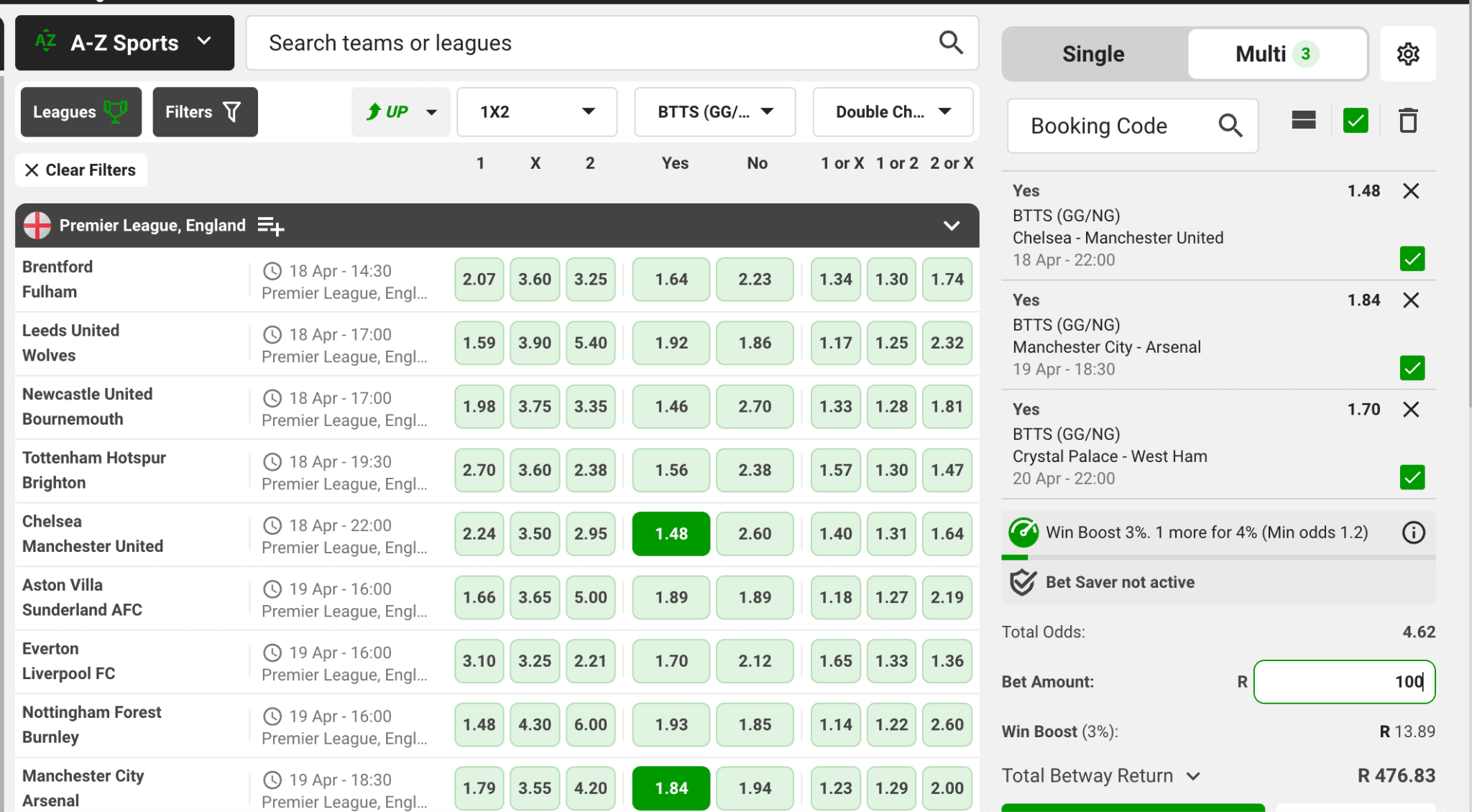
The 3-Leg Multi
I recently placed a R100 stake on three EPL BTTS Yes selections at Betway, with a 3% win boost applied to the potential return:
Match | BTTS Yes | BTTS No | Implied Prob (Yes) | Vig (per leg) | True Win Prob |
Chelsea vs Man Utd | 1.48 | 2.60 | 67.57% | 6.03% | 63.73% |
Man City vs Arsenal | 1.84 | 1.94 | 54.35% | 5.90% | 51.32% |
Crystal Palace vs West Ham | 1.70 | 2.12 | 58.82% | 5.99% | 55.50% |
The compounded vig across the three legs was 19.01% (1.063 x 1.0590 x 1.0599), while after removing the vig from the odds, my true win compound probability was only 18.1%. My expected value was -R16.38 per R100 staked, calculated as: (0.181 × 4.62) − 1 = −0.1638, or −16.38% EV.
Adding the Fourth Leg
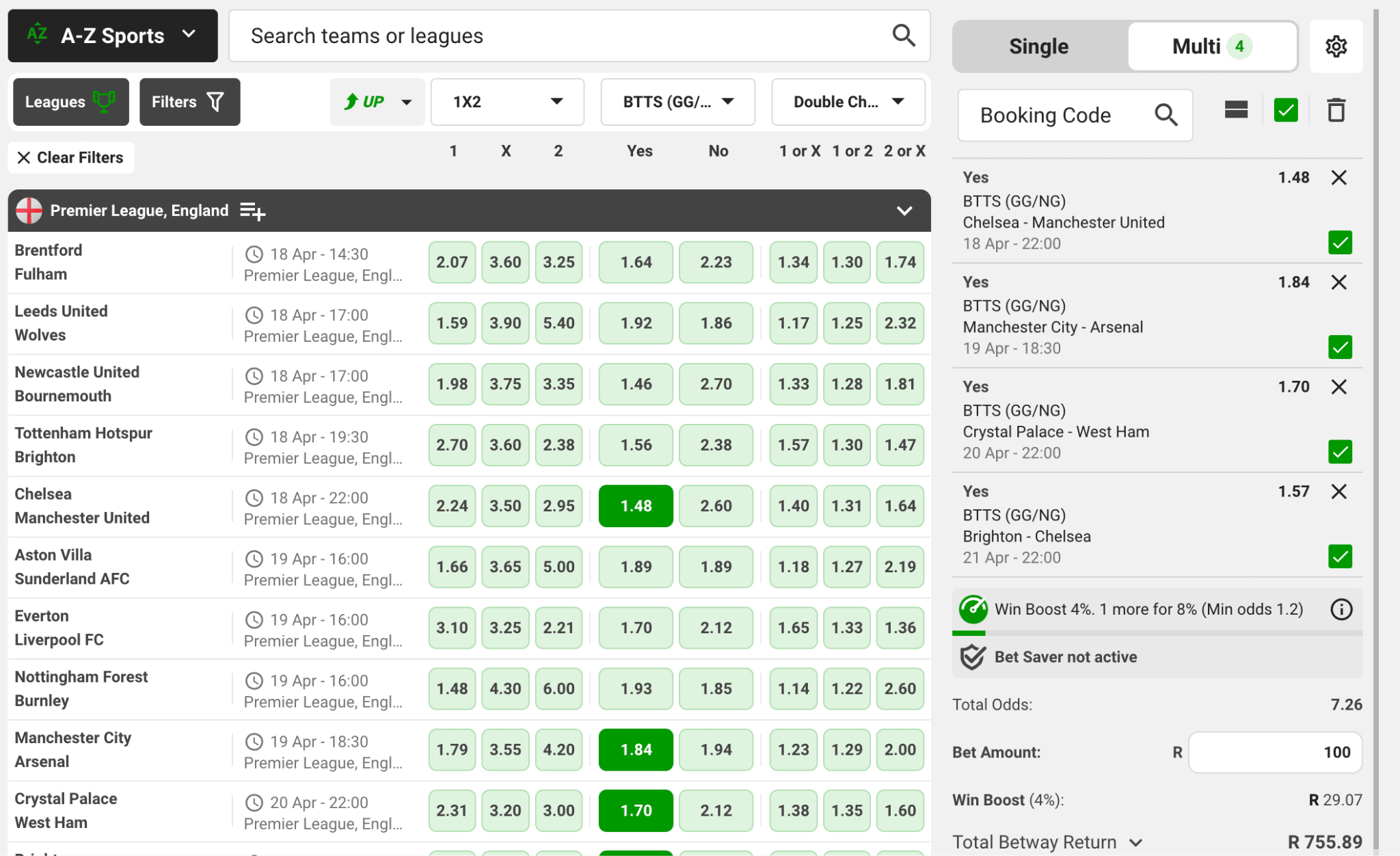
Adding the Fourth Leg
I was considering adding another leg to my multi: Brighton vs Chelsea BTTS Yes at 1.57 (No at 2.37). This extra selection caused the odds to jump to 7.26, the win boost to surge to 4%, and my potential return to rise to R755.89.
Match | BTTS Yes | BTTS No | Implied Prob (Yes) | Vig (per leg) | True Win Prob |
Chelsea vs Man Utd | 1.48 | 2.60 | 67.57% | 6.03% | 63.73% |
Man City vs Arsenal | 1.84 | 1.94 | 54.35% | 5.90% | 51.32% |
Crystal Palace vs West Ham | 1.70 | 2.12 | 58.82% | 5.99% | 55.50% |
Brighton vs Chelsea | 1.57 | 2.37 | 63.69% | 5.88% | 60.16% |
However, adding just one more leg pushed the bookmaker’s compounded margin from 19.1% to 26.1%, a sharp 7 percentage point increase in their edge. At the same time, my true win probability dropped from 18.1% to 10.9%.
In practical terms, I’ve gone from roughly a 1-in-5.5 chance to a 1-in-9 shot. The potential payout looks more attractive. But unless you're betting with free bets it doesn’t come close to offsetting the accumulator variance and how much harder the bet becomes to actually win, which is why I ultimately decided to stick with the 3-leg multi.
Metric | 3-Leg Multi | 4-Leg Multi | Change |
Combined odds | 4.62 | 7.26 | +57% |
Potential return (R100 stake) | R476.83 | R755.89 | +58.5% |
Compound vig | 19.14% | 26.14% | +7.0 pts |
True win probability | 18.14% | 10.92% | -7.2 pts |
Win boost applied | 3% | 4% | +1 pt |
How Edge Compounds
The same compounding mechanism that works against you when you have zero edge is your friend when you have positive expected value. Let's say your edge on each leg is either -2% or +2%, you just use a geometric progression to determine your expected return.
Legs | -2% Edge Per Leg | +2% Edge Per Leg |
1 | -2.00% | +2.00% |
2 | -3.96% | +4.04% |
3 | -5.88% | +6.12% |
4 | -7.76% | +8.24% |
If you're backing legs with no edge, adding more legs is compounding a guaranteed drain. But if you've identified real value, then adding more positive-edge legs compounds that advantage just as aggressively as the vig compounds against you.
Summing Up
More legs equals additional risk. Every selection you add compounds the bookmaker's vig against you while simultaneously reducing your probability of winning, and any boosts bookies offer rarely make up for this.
However, if every leg on your slip carries a positive edge, you should absolutely keep adding selections because that edge compounds, so much so that a small 2% edge for each selection in a 4-leg multi creates an 8.24% expected return!

Chad’s career in the sports betting industry began in October 2013 when he joined Hollywoodbets. During his time there, he wrote football betting content for the Hollywoodbets Sports Blog and contributed extensively to their weekly betting publication, Soccer Betting News. His work and leadership eventually led to him being appointed Editor-in-Chief of the publication in February 2016.
Related Resources to Betting Academy
- Implied Probability: How to Read Transfer Odds Easily
- Why Aviator Appeals to Sports Bettors
- Responsible Gambling in South Africa: How to Set Betting Limits
- Loss Aversion: Why Broken Accas Hurt More Than Wins
- Why 1000 Slot Spins Beat a Football Match in Predictability
- House Edge vs Betting Margin: What’s Fairer for Punters?
- Why Long Multiples Appeal to South African Bettors
- PSL Betting Guide: Ignore Streaks, Focus on Data
- Why Bettors Prefer Fast Games Over 90-Minute Matches
- How to Use Casino Games to Keep Your Bankroll Active for the 2026 World Cup
- When to Cash Out a Bet Early? A Guide for Football Fans
- How Injuries Shift Betting Odds and Move the Line
- FICA for Beginners: Getting Your Account Ready Before Kick-Off
- Top Soccer-Themed Spina Zonke Games to Play in the Off-Season
- Are PSL Gambling Sponsors Legal in South Africa?
- Why R5 Aviator Bets Are Trending in Sports Bars
- How Release Clauses Affect Transfer Odds
- What to Bet On During Soccer’s Off-Season in South Africa
- Understanding Decimal vs Fractional Betting Odds
- Treble Bets Explained How 3 Leg Accumulators Work in 2026