
Betting Academy
House Edge vs Betting Margin: What’s Fairer for Punters?
The assumption among many South African punters is that sports betting is “safer” than casino games. While the logic is simple, betting on a football match involves a level of knowledge, while Blackjack seems to be pure chance. The problem with this argument is that it ignores how much an operator is mathematically taking from you.

SportsBoom offers honest and impartial bookmaker reviews to help you make informed choices. While we may earn commissions through affiliate links, our content remains independent and free from promotional influence. For more information, see our Content Transparency and How We Review pages.
House Edge vs Betting Margin
A punter who plays R100 on a Betway Premiership fixture may feel more informed than, say, a player at a Live Blackjack table, but the real difference is found in the margin efficiency, theoretical advantage, and how mathematical fairness plays out.
Understanding the Core Difference
A game like Blackjack has a house edge. This is a built-in mathematical advantage that the casino has over the player. In simple terms, it means that over many hands, the casino expects to retain R2,50 for every R100 wagered.
Sports betting is different; vigorish or overround is employed here. This is something embedded in the advertised odds, so instead of showing true odds, the betting site slightly reduces the payouts on all outcomes to ensure their margin is guaranteed.
Why Lower House Edge Can Mean Better Value
The math says that a 2.5% house edge is a lower theoretical advantage than a 10% bookmaker margin. Why does this matter?
Well,
- In Blackjack, the expected loss per R100 is about R2.50
- In a 10% overround market, the expected loss per R100 can approach R10 (depending on how efficiently you pick odds)
There is no speculation here; this is linked directly to probability and payout structures.
Of course, the nuance is that Blackjack is a game governed by random rules while sports betting is dependent on real-world events, but the illusion this creates is that skill can overcome bookmaker margins.
Why Bettors Often Misjudge This
There are reasons why South African bettors lean toward sports betting. Here are some of my favourites.
Perceived Control
Following leagues like the Betway Premiership creates a sense of insight, but knowing the team doesn’t automatically make the odds mispriced.
Event-Based Thinking
A single game of football feels less random than a card game. Irrespective, though, probability governs these outcomes.
Hidden Margins
The vigorish is not always visible. The house edge is often clearly stated, but the bookmaker's margins are embedded in odds, which will always make them harder to detect.
A Practical South African Scenario
A Practical South African Scenario
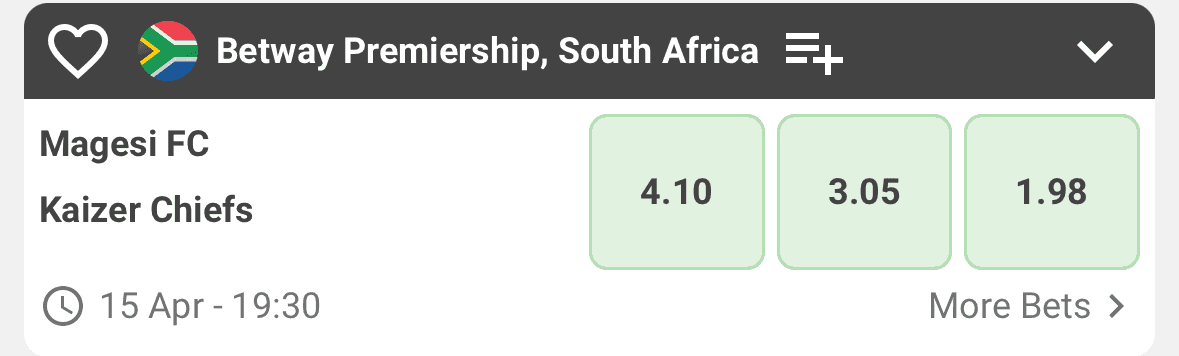
The advertised odds on the Kaizer Chiefs win include a bookmaker margin of around 5%. That means, even if I were to complete an average of 50% correct calls, the return is slightly negative due to the bookmaker’s margin.
Blackjack, on the other hand, has a house edge of 2.5%. The mathematical expected loss here is lower than in a sports betting option. This doesn’t mean Blackjack is better; it just speaks to the idea that mathematical fairness depends on the size of the edge.
Where Margin Efficiency Comes In
Margin efficiency is how much value you retain from each bet, relative to the operator's cut.
- Lower edge (2.5%) = more efficient
- Higher margin (10%) = less efficient
From a purely analytical standpoint, a lower edge means your bankroll lasts longer over time, assuming consistent play.
However, sports betting introduces variance and the possibility (not guarantee) of identifying value. This will always speak to experienced and seasoned punters, especially those who keep abreast of a particular sports environment.
The Real-World Implication
The key takeaway here is not that casino games are “better” than sports betting. It’s simply that punters underestimate how much bookmakers take through odds. A 10% overround is objectively larger than a 2.5% house edge. That difference compounds over time, especially for frequent bettors using mobile platforms and placing small, repeated wagers.
Conclusion: What “Fair” Actually Means
In the context of betting, fairness is not about skill or knowledge. It is simply about the built-in advantage against you. A lower house edge in Blackjack represents a smaller theoretical advantage than a high bookmaker vigorish in Betway Premiership markets.
For South African punters, the lesson is to consider moving away from exclusively seeking predictions and consider the cost of the market you are playing in.

Ryan Liberty is a sportswriter known for his conversational style and ability to make content feel both engaging and easy to follow. With a genuine passion for sport, his work is driven by a love for football, horseracing, Formula One, and tennis, among others, allowing him to cover a wide range of topics with confidence.
Related Resources to Betting Academy
- Why 1000 Slot Spins Beat a Football Match in Predictability
- Why Long Multiples Appeal to South African Bettors
- PSL Betting Guide: Ignore Streaks, Focus on Data
- Why Bettors Prefer Fast Games Over 90-Minute Matches
- How to Use Casino Games to Keep Your Bankroll Active for the 2026 World Cup
- When to Cash Out a Bet Early? A Guide for Football Fans
- How Injuries Shift Betting Odds and Move the Line
- FICA for Beginners: Getting Your Account Ready Before Kick-Off
- Top Soccer-Themed Spina Zonke Games to Play in the Off-Season
- Are PSL Gambling Sponsors Legal in South Africa?
- Why R5 Aviator Bets Are Trending in Sports Bars
- How Release Clauses Affect Transfer Odds
- What to Bet On During Soccer’s Off-Season in South Africa
- Understanding Decimal vs Fractional Betting Odds
- How Fake Transfer Rumours Affect Betting Odds and Price Drift
- Transfer Betting Explained: How Medicals Affect Odds & Market Value
- Why Transfer Rumours Shift Betting Odds Quickly
- What Is Single Betting How It Works with Strategy Tips in 2026
- Treble Bets Explained How 3 Leg Accumulators Work in 2026
- Why Transfer Odds Move Before the News?