
Betting Academy
Why 1000 Slot Spins Beat a Football Match in Predictability
For many South African punters, the notion that “anything is possible” when it comes to both slots and football betting is incredibly popular. Granted, there is some truth to the statement, but it's not as simple as it sounds. Not all betting events behave in the same way over time; a 90-minute PSL match and 1000 slot spins might both feel unpredictable, but the mathematics suggest one is far more predictable than the other.
Welcome to the relevance of the law of large numbers. It outlines why outcomes stabilise and others remain volatile in certain environments.

SportsBoom offers honest and impartial bookmaker reviews to help you make informed choices. While we may earn commissions through affiliate links, our content remains independent and free from promotional influence. For more information, see our Content Transparency and How We Review pages.

The Law of Large Numbers
Understanding the Concept
The law of large numbers is a statistical concept, which sees the sample volume increase and, as a result, the average outcome moves closer to what is expected. What does this mean simply?
- The more times you repeat an event, the more predictable the overall results become.
- This does not mean each individual outcome becomes predictable.
For example, Gates of Olympus from Pragmatic Play on Betway has an RTP (Return to Player) of 96%. This does not mean we will get R96 back from a R100 spent, however, over thousands, or millions, of spins the game will move closer to this 96% rate. It is a gradual alignment known among punters as convergence.

Understanding the Concept
Why Bettors Misunderstand This
Unfortunately, both online casino players sports punters often see short-term outcomes as meaningful indicators of long-term expected behaviour. What I mean by this is:
- I place R50 on a PSL match and lose due to a late goal.
- You spend R50 on 20 slot spins and hit a small win.
These two instances both seem rather random – and in a way, they certainly are. But the key difference here is in the statistical significance.
The football match is influenced by countless variables (team form, injuries, weather, etc.) and there is no repetition within that football betting event. Therefore, there won’t be any averaging out.
Where the Logic Breaks
Shall we then compare these two hypothetical scenarios?
The PSL Football Bet
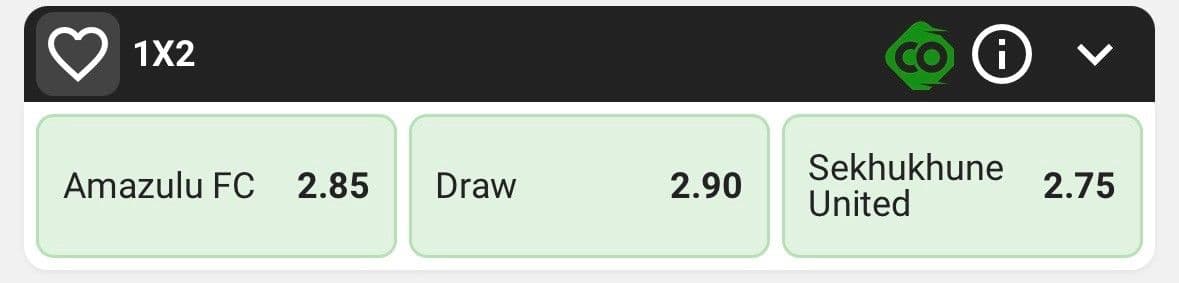
The PSL Football Bet
Assume I placed R100 on AmaZulu FC to win this game. The possible winning outcome is that I walk away with R285, or I lose my R100. The number of trials available here is just one.
Even if the odds are fair, the bettor must shoulder full variance in a single result. There are no opportunities for outcomes to balance out.
Slot Session
If I were to now rather place a bet of R100 on 1000 micro-stakes spins (R0.10 each) with Gates of Olympus, the RTP sits at 96%, and the number of trials is 1000.
Importantly, each spin is independent whilst collectively creating a large dataset. Over time, the results will move toward reflecting the expected return. Now, while short-term variance will obviously exist, the larger sample volume will reduce extreme deviations.
This is where the importance and power of convergence play a pivotal role.
Real-World Implications for South African Bettors
In South Africa, most punters use betting apps with relatively small amounts on focused markets like the PSL and EPL. The mathematics suggests the following:
- Sports betting is inherently high variance
A single bet does not benefit from the Law of Large Numbers. Even if a bettor consistently selects fair odds, outcomes remain volatile in the short term.
- Casino games rely on volume for predictability (at scale)
Slot outcomes become more stable only across large datasets—typically far beyond what an individual player experiences in one session.
To clarify, I am not suggesting that slots betting is safer or inherently of real value; both options include a house edge, the difference is simply in how the outcomes behave statistically.
Long-Term ROI vs Short-Term Experience
The concept of long-term return on investment (ROI) is something horribly misunderstood.
- In slots, the RTP represents a theoretical long-term return across millions of spins.
- In sports betting, ROI depends on consistently finding value relative to odds.
The reality is that casual bettors do not bet enough to reach meaningful statistical significance, and this results in narratives like “I’m unlucky” or “This slot pays well” dominating the thinking.
Where the Law Applies – and Where it Doesn’t
The Law of Large Numbers only applies when:
- The same event is repeated many times
- Each outcome is independent
- The probabilities remain consistent
Slots achieve this, not sports matches.
Conclusion: Different Types of Uncertainty
If nothing else, the key takeaway here is that one is not better than the other. These betting options operate under different statistical conditions. Understand the difference, make informed decisions with relative expectations, and welcome the inherent risk.

Ryan Liberty is a sportswriter known for his conversational style and ability to make content feel both engaging and easy to follow. With a genuine passion for sport, his work is driven by a love for football, horseracing, Formula One, and tennis, among others, allowing him to cover a wide range of topics with confidence.
Related Resources to Betting Academy
- House Edge vs Betting Margin: What’s Fairer for Punters?
- Why Long Multiples Appeal to South African Bettors
- PSL Betting Guide: Ignore Streaks, Focus on Data
- Why Bettors Prefer Fast Games Over 90-Minute Matches
- How to Use Casino Games to Keep Your Bankroll Active for the 2026 World Cup
- When to Cash Out a Bet Early? A Guide for Football Fans
- How Injuries Shift Betting Odds and Move the Line
- FICA for Beginners: Getting Your Account Ready Before Kick-Off
- Top Soccer-Themed Spina Zonke Games to Play in the Off-Season
- Are PSL Gambling Sponsors Legal in South Africa?
- Why R5 Aviator Bets Are Trending in Sports Bars
- How Release Clauses Affect Transfer Odds
- What to Bet On During Soccer’s Off-Season in South Africa
- Understanding Decimal vs Fractional Betting Odds
- How Fake Transfer Rumours Affect Betting Odds and Price Drift
- Transfer Betting Explained: How Medicals Affect Odds & Market Value
- Why Transfer Rumours Shift Betting Odds Quickly
- What Is Single Betting How It Works with Strategy Tips in 2026
- Treble Bets Explained How 3 Leg Accumulators Work in 2026
- Why Transfer Odds Move Before the News?