
Betting Academy
Implied Probability: How to Read Transfer Odds Easily
When bookmakers post transfer odds, buried inside those numbers is a percentage that reveals how likely the market believes a transfer is to happen.

SportsBoom offers honest and impartial bookmaker reviews to help you make informed choices. While we may earn commissions through affiliate links, our content remains independent and free from promotional influence. For more information, see our Content Transparency and How We Review pages.
Implied Probability
It takes 30 seconds to calculate implied probability, but when done right, it can tell you whether the hype around a signing is real or already priced in.
What Is Implied Probability?
Every set of transfer odds is a bookmaker's estimate of likelihood, translated into a number designed to ensure profit. When you reverse-engineer that number back into a probability, you get what traders call the implied probability - the market's collective belief about whether a deal will happen.
Implied probability equals 1 divided by the decimal odds, multiplied by 100 to give a percentage. So if a club is priced at 1.33 to sign a player, the percentage conversion is 1 ÷ 1.33 x 100, which gives you 75.2%.
The market is saying that the transfer has roughly a three-in-four chance of completing. At 3.00, the implied probability is 33.3%.
However, these raw percentages are inflated by the bookmaker’s margin (overround). To correct this, traders use margin removal:
Convert each price into implied probability
- 1.80 → 1 ÷ 1.80 x 100 = 55.6%
- 2.10 → 1 ÷ 2.10 x 100 = 47.6%
Add them together:
55.6 + 47.6 = 103.2%
Remove the margin by normalising
- “Move” = (55.6 ÷ 103.2) x 100 = 53.9%
- “Stay” = (47.6 ÷ 103.2) x 100 = 46.1%
Erling Haaland to Manchester City Summer 2022
Erling Haaland to Manchester City Summer 2022
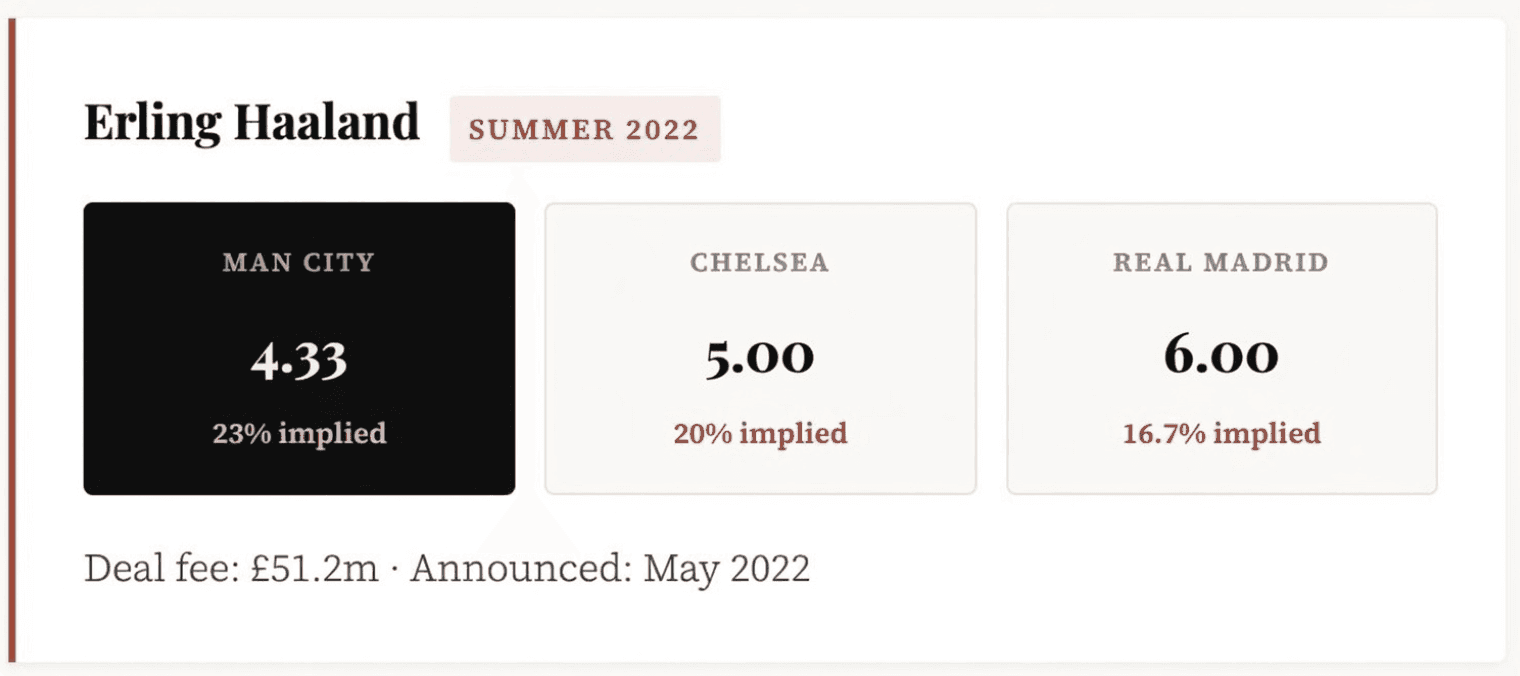
As late as February 2022, South African betting sites had Manchester City priced at around 4.33 to sign Haaland, an implied probability of just 23%. Chelsea were close behind at 5.00 (20% implied), with Real Madrid and Bayern Munich also active in the market.
The reason for the uncertainty was Pep Guardiola. The manager had spent years publicly insisting he didn’t need a traditional striker. But what those odds couldn't fully capture was the impact of a R1.136 billion release clause set to activate in the summer of 2022.
Once activated, it narrowed the field. Dortmund couldn't hold out for the R3.329 billion fee they'd publicly floated. The clause was the mechanism, and the market, at 23%, had significantly underpriced it.
Those who identified that logic and backed City at 4.33 were value hunting. Haaland signed for City in May for R1.136 billion and went on to score 36 Premier League goals in his debut season, and the fee now looks like one of the bargains of the era.
Declan Rice to Arsenal Summer 2023
Declan Rice to Arsenal Summer 2023
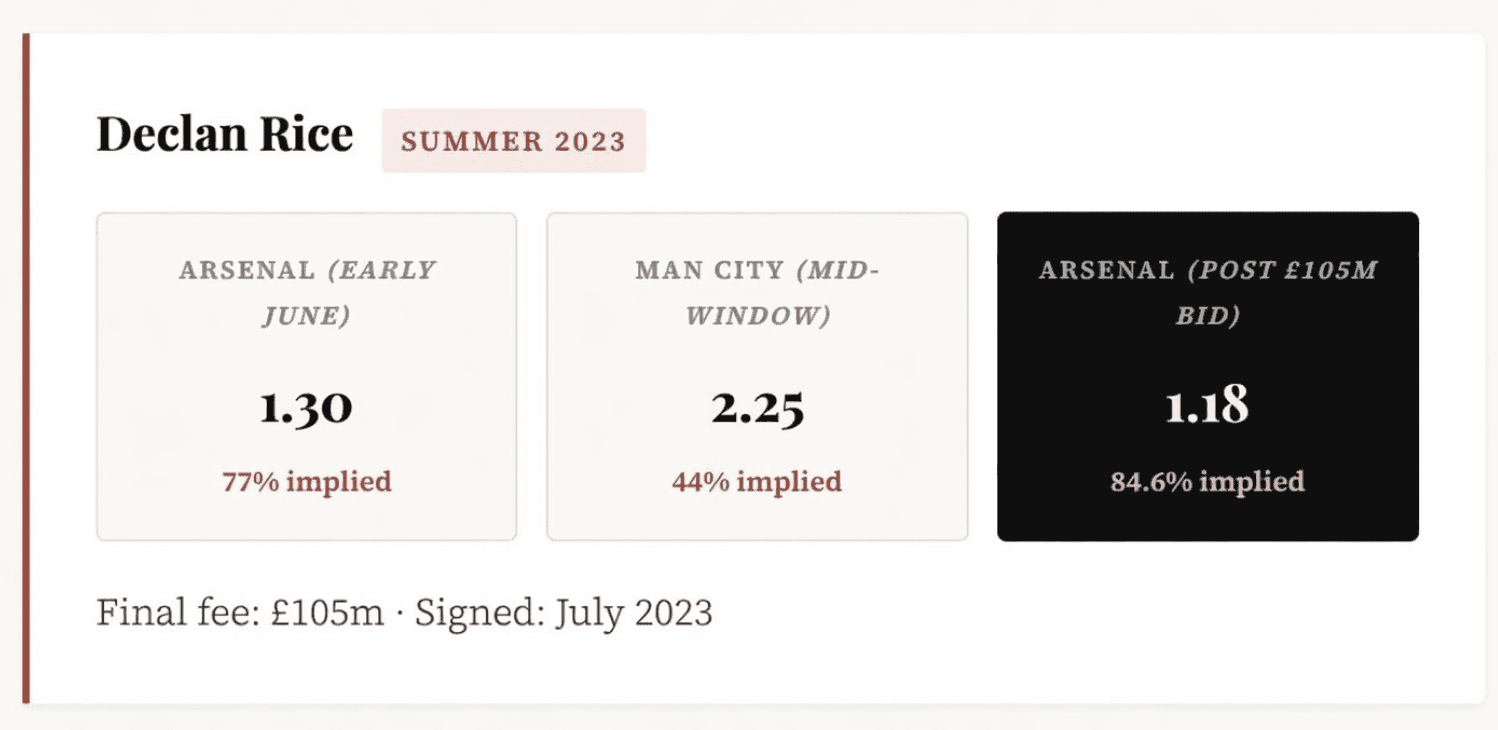
Arsenal were installed as early favourites shortly after West Ham won the Europa Conference League in June 2023. With the club's chairman publicly acknowledging Rice would be allowed to leave and the player known to prefer a move to north London, bookmakers had Arsenal at around 1.30, an implied probability of 76.9%.
The market was turned on its head by Manchester City's sudden entry. When City submitted a R1.99 billion bid, which was rejected by West Ham, their odds compressed sharply, briefly pushing them toward near parity with Arsenal. A punter looking at the market in that moment would have seen City at roughly 2.27 (44% implied) versus a temporarily reduced Arsenal. The bookies were treating it as a two-horse race.
Then Arsenal placed their R2.33 billion third bid, and their odds moved to around 1.18, an implied probability of 84.6%. At that point, the movement itself was the signal and highlighted price accuracy.
Rice signed for Arsenal days later, becoming the most expensive British player in history at the time. The market had called it with high accuracy from relatively early in the window.
How to Use Implied Probability When Assessing EPL Transfers
Look for factors the market may be ignoring, like release clauses, expiring contracts, public statements from directors, and a player's known preferences. In Haaland's case, the clause was the key variable that the 23% figure underweighted.
Track the movement of the odds and velocity of the shift. A team moving from 15% to 50% implied probability in 48 hours is more informative than a team sitting statically at 60%.
Rapid odds shortening is often the result of credible rumours from well-respected journalists or insiders placing bets. The Rice’s transfer odds moving from 77% to 84.6% in a single news cycle was essentially the market confirming what insiders already knew.
Finally, treat any favourite below 40% implied as an open market. Above 70%, the market is essentially confirming the deal.
Transfer odds are never a perfect oracle. Bookmakers react to the same rumours fans do, and markets can be moved by large speculative bets or tabloid noise. I recommend you use them as a way to ask whether the collective market knows something you don't!

Chad’s career in the sports betting industry began in October 2013 when he joined Hollywoodbets. During his time there, he wrote football betting content for the Hollywoodbets Sports Blog and contributed extensively to their weekly betting publication, Soccer Betting News. His work and leadership eventually led to him being appointed Editor-in-Chief of the publication in February 2016.
Related Resources to Betting Academy
- Adding One More Leg to Your Multi?
- Why Aviator Appeals to Sports Bettors
- Responsible Gambling in South Africa: How to Set Betting Limits
- Loss Aversion: Why Broken Accas Hurt More Than Wins
- Why 1000 Slot Spins Beat a Football Match in Predictability
- House Edge vs Betting Margin: What’s Fairer for Punters?
- Why Long Multiples Appeal to South African Bettors
- PSL Betting Guide: Ignore Streaks, Focus on Data
- Why Bettors Prefer Fast Games Over 90-Minute Matches
- How to Use Casino Games to Keep Your Bankroll Active for the 2026 World Cup
- When to Cash Out a Bet Early? A Guide for Football Fans
- How Injuries Shift Betting Odds and Move the Line
- FICA for Beginners: Getting Your Account Ready Before Kick-Off
- Top Soccer-Themed Spina Zonke Games to Play in the Off-Season
- Are PSL Gambling Sponsors Legal in South Africa?
- Why R5 Aviator Bets Are Trending in Sports Bars
- How Release Clauses Affect Transfer Odds
- What to Bet On During Soccer’s Off-Season in South Africa
- Understanding Decimal vs Fractional Betting Odds
- Treble Bets Explained How 3 Leg Accumulators Work in 2026